
In This Article
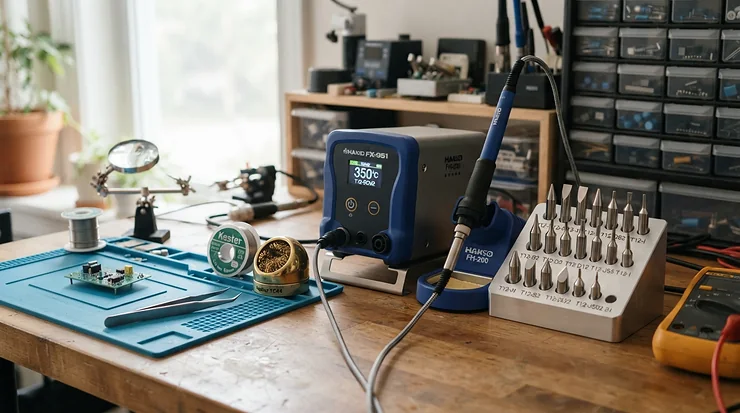
A soldering station with extra tips for repair shops is a temperature-controlled soldering base paired with a handpiece and a spare set of interchangeable tips (chisel, conical, bevel, micro). A technician can then move from a stubborn charging port to a tiny resistor without changing tools or waiting on a shipment. ⚡
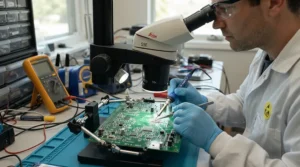
Repair benches rarely fail because a station is underpowered. They fail at 4:45 on a Friday, when the only chisel tip is oxidized, the fine conical is back-ordered, and a customer is hovering at the counter asking about a USB-C port. Wattage gets the marketing. Tip availability pays the rent.
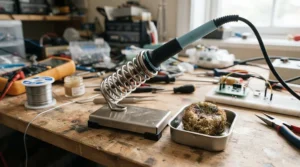
At its core, a soldering iron is a hand tool that supplies enough heat to melt solder into a joint. The station wrapped around it turns a hot stick into a controlled instrument, and the tip ecosystem decides how many kinds of jobs that instrument can handle.
This guide ranks seven real, currently sold stations using published specifications, manufacturer documentation, and aggregated reviewer sentiment. None of it comes from staged “I tested it for a week” theatrics. Along the way you’ll get a plain-English look at ESD-safe grounding for micro soldering, whether a kit is enough for a working shop, how to stock replacement tips, and how to build the bench around the station. Prices are shown as ranges only, so always check the current price before you buy.
Quick Comparison: 7 Stations at a Glance
| Product | Power | Tip System | Tips in the Box | Price Range | Best For |
|---|---|---|---|---|---|
| Hakko FX-888DX | 65W handpiece | T18 | 1 (T18-D16) | Around $120-$160 | General phone/laptop repair |
| Weller WE1010NA | 70W | ET series | 1 (ETA 1.6 mm) | Around $150-$250 | Mixed-device benches |
| YIHUA 926 III | 60W | 900M-style | 6 in kit | Under about $60 | Startups and training benches |
| Hakko FX-971 | 100W | T39 (60+ shapes) | None | Roughly $330-$450 | Growing multi-tech shops |
| JBC CD-2BF | C245 cartridge | C245 (150+ options) | 2 cartridges | Well above $500 | High-volume professional benches |
| AIXUN T420D | 200W rated, dual channel | C245 / C210 / C115 | 6-9 depending on set | Roughly $350-$600 | Micro-soldering phone shops |
| Metcal MX-5200 | 80W, dual port | SmartHeat cartridges | Varies by configuration | Roughly $1,400-$1,600 | Shops that want ground monitoring |
The table splits cleanly into three camps. The YIHUA 926 III wins on included tips per dollar, the Hakko FX-888DX and Weller WE1010NA win on all-round reliability, and the premium trio (JBC CD-2BF, AIXUN T420D, Metcal MX-5200) wins on speed and fine-pitch capability. Notice how few stations ship with more than one or two tips, and budget for that gap from day one.
💬 Just one click — help others make better buying decisions too!😊
Top 7: Soldering Station With Extra Tips for Repair Shops, Analyzed
1. Hakko FX-888DX — T18 tip ecosystem is hard to beat
The standout here isn’t the station itself. It’s the T18 tip family, a shelf of chisel, bevel, conical and knife shapes that most electronics distributors stock on any given Tuesday. For a working shop, that availability is worth more than any line on a spec sheet.
The Hakko FX-888DX pairs a 65W FX-8801 handpiece with a ceramic heater, a 50-480°C range and a published stability of ±1°C. In practice, the tip holds its temperature when it lands on a ground plane instead of dipping and overshooting, which is how pads get lifted. The rotary encoder, five presets and password lock keep a shared bench from drifting between technicians. Tip-to-ground potential is listed under 2 mV and resistance under 2 ohms, and the station meets IPC J-STD-001 requirements.
Based on the spec comparison, this is the “default answer” for phone boards, laptop DC jacks and console HDMI ports. Heavy ground-plane work is its limit, unless you add the optional 95W FX-8806 handpiece, which uses the separate T32 tips. Only one tip (the T18-D16 chisel) ships in the box, so plan to add a larger chisel and a fine conical early.
Published roundups and forum threads repeatedly praise the intuitive encoder and long-term durability. The main practical note is the single tip in the box.
Pros:
- ✅ Stable ±1°C closed-loop temperature control
- ✅ Huge T18 tip availability and shape range
- ✅ ESD-safe tip grounding, IPC J-STD-001 compliant
Cons:
- ❌ Only one tip included in the box
- ❌ 65W handpiece struggles on heavy ground planes
Price: around $120-$160, which makes it a strong-value, low-regret general bench station.
2. Weller WE1010NA — 70W punch with calibration control
The Weller WE1010NA stands out for thermal headroom at a sensible price. Its 70W handpiece is billed by Weller as 40% more powerful than the older WES/WESD stations it replaced.
The range runs 200-850°F with ±4°F stability, a temperature offset function, password lock, standby and auto-setback modes, and ESD-safe, UL-listed construction. The offset matters more than it sounds: one owner described dialing in a quick −2°C correction against a reference reading. That is exactly how a shop keeps several stations honest with one another. It ships with the PH70 safety rest and sponge plus a 1.6 mm ETA screwdriver tip. It accepts only Weller ET-series tips, so Hakko tips won’t fit. Choosing this station means committing to the ETA, ETH, ETK and ETO families.
Analytically, this is a great pick for mixed benches where one technician does a phone in the morning and a laptop motherboard after lunch. Just remember the LCD isn’t backlit, which stings in a dim corner of the shop.
One retail listing shows more than 4,400 reviews averaging roughly 4.7 out of 5 at the time of research. Reviewers highlight build quality and value, and the unlit display is the recurring nitpick.
Pros:
- ✅ 70W handpiece with strong thermal headroom
- ✅ Offset calibration and password-locked settings
- ✅ Wide range of ET-series tip shapes
Cons:
- ❌ ET-only tips, so no Hakko tip crossover
- ❌ LCD isn’t backlit
Price: around $150-$250, with a one-year warranty. A solid value for a professional general-purpose bench.
3. YIHUA 926 III — 12-in-1 kit with six tips
Here is the only entry that ships with real tip variety in the box. Six tips for the price of a nice dinner is the closest thing to “extra tips” at the budget end, and that is the whole pitch.
The YIHUA 926 III offers 60W from a ceramic heater, a 194-896°F (90-480°C) range, PID stabilization, sleep mode, calibration support and °C/°F switching. It runs on 110-127V only. The 12-in-1 kit adds two helping hands, six 900M-series-style tips, lead-free solder, a solder sucker, ESD-safe tweezers and a wire dispenser. In practice that means a new bench can start repairing the day the box opens, and cheap, widely sold tips make a lost tip a minor annoyance.
The honest take is that 60W is modest. Heavy ground planes will tire it out, and one listing notes the sensor reads the heating element rather than the tip, so verify temperature with a thermometer. Treat it as a startup station, a training bench, or the spare at the counter.
Across roughly 7,000 reviews at about 4.4 out of 5, buyers praise value and fast heat-up. Complaints cluster around unit-to-unit quality variance, flimsy helping hands, and element longevity under heavy use.
Pros:
- ✅ Six tips plus a full accessory kit included
- ✅ PID stabilization with sleep mode and calibration
- ✅ Very low entry cost
Cons:
- ❌ Quality variance reported between units
- ❌ 60W can be outgrown at 20+ devices daily
Price: under about $60. Excellent starter value, but high-volume shops will likely graduate from it.
4. Hakko FX-971 — micro-handpiece ready with 60+ tip shapes
The Hakko FX-971 earns its slot through the T39 tip family, which spans more than 60 shapes, and an upgrade path to a dedicated micro handpiece (the FX-9703) and a nitrogen version (the FX-9702).
The station delivers 100W with a 50-450°C range and ±3°C stability at idle. It adds five presets, a sleep timer, auto shut-off and password lockout. The large tilted display is easy to read from a seated position, and USB connectivity to Hakko’s control software supports performance monitoring and auto-calibration. Tip-to-ground resistance is listed under 2 ohms and potential under 2 mV, so it holds up on the ESD front.
The catch: tips are not included. Add handpiece and tips and the real cost sits well above the sticker, so shop it as a system. If two technicians share one bench, Hakko’s dual-port FX-972 (200W) is the sibling to look at.
As a newer model, verified customer review volume is thinner than for the older Hakko FX-888DX. Hakko positions it as the successor to its long-running FX-951, which the company calls among the most reliable stations in the industry. That is the manufacturer’s claim, not independent proof.
Pros:
- ✅ T39 family covers 60+ tip shapes
- ✅ Micro and nitrogen handpiece upgrade options
- ✅ Software monitoring and auto-calibration support
Cons:
- ❌ No tips included in the box
- ❌ Priced well above the Hakko FX-888DX
Price: roughly $330-$450 before tips. Worth it for growing, multi-technician shops.
5. JBC CD-2BF — cartridge speed with sleep-mode tip life
JBC’s trick is the cartridge. The heater and sensor sit inside the tip itself, so a swap takes seconds and heat arrives where the solder is. One retailer review of the predecessor CD-2BE singled out a heat-up time under five seconds.
The JBC CD-2BF is the upgraded successor to the CD-2BE. It supports over 150 C245 cartridges and ships with a conical Ø1 (C245-903) and a 2.4 × 0.6 chisel (C245-741). A cartridge holder stores up to four, and an RJ12 port connects to JBC’s fume extractor. JBC advertises that sleep and hibernation modes extend tip life five-fold, a manufacturer claim worth treating as a ceiling rather than a promise.
The practical advantage is that C245 is a shared standard. Several third-party stations accept C245 tips, which widens replacement choice, although clone quality varies. A caution: JBC states the CD station family can’t drive a tweezer handpiece, so thermal tweezers mean a different station.
Verified consumer review volume is thin because these units sell through industrial channels, so lean on technician forums and spec sheets. A shop billing by the hour should price downtime, not just hardware.
Pros:
- ✅ Cartridge swaps take seconds
- ✅ 150+ C245 cartridges to choose from
- ✅ Sleep and hibernation protect tip life
Cons:
- ❌ Premium price tier
- ❌ No tweezer handpiece support
Price: well above $500. Strong value for high-volume professional benches.
6. AIXUN T420D — dual channels and three handle types
Two handles live at once from one station. The AIXUN T420D is rated at 200W (400W peak) and supports T245, T210 and T115 handles with C245, C210 and C115 tips, spanning heavy connectors down to micro-pitch SMD work.
Why does that matter? A technician can keep a fine C115 handle in one hand-rest for 0402 parts and a C245 for shields and connectors in the other, with no swapping. Manufacturer listings claim heat to 350°C in one to two seconds, 90-450°C range and a 12-month warranty, and handle sets bundle six to nine tips depending on configuration.
The caveats are the honest kind. Forum owners of the single-channel T420 reported a clicking sound with a C115 handle, and ESD grounding specifications vary by seller, so confirm them in writing before assuming the station meets your shop’s ESD program. One forum poster liked that T115 tips handle tiny SMD parts where the smallest T12 tip is too big, and another pointed out the price premium over simpler stations.
Pros:
- ✅ Two handles active simultaneously
- ✅ C115, C210 and C245 tips cover micro to large
- ✅ Bundled sets include six to nine tips
Cons:
- ❌ ESD specs vary by seller, so verify them
- ❌ Support depends on the reseller (12-month warranty)
Price: roughly $350-$600 depending on handle set. A smart pick for micro-soldering phone shops.
7. Metcal MX-5200 — dual-port, self-regulating cartridge tips
The Metcal MX-5200 series’ defining feature is SmartHeat, a self-regulating heater built into each cartridge that senses its own temperature. It offers 80W across two simultaneous ports with hundreds of compatible tip models.
Mix and match handpieces: the MX-H1-AV standard iron, the MX-H2-UF ultra-fine, the MX-PTZ tweezer and the MX-DS1 desoldering handpiece can all share one system. The MX-PS5200 power supply is described as ESD safe with incoming AC ground monitoring, so it can flag a lost ground, which is a rare and genuinely useful safeguard for a shop running an ESD program.
Analytically, this is the “one system” answer for benches that solder, desolder and rework with tweezers all day. The cost is the obvious drawback, and the cartridge assortment adds to the bill.
Verified consumer review volume is limited, since the series mostly moves through industrial distributors, so judge it on specs and technician feedback.
Pros:
- ✅ Ground-monitoring ESD power supply
- ✅ Iron, tweezers and desoldering in one system
- ✅ Self-regulating cartridge heating
Cons:
- ❌ Highest price in this lineup
- ❌ Cartridge assortment adds to total cost
Price: roughly $1,400-$1,600 for popular configurations. Best value for shops that live on rework volume.
Top 7 at a Glance: Specs, Grounding and Review Sentiment
| Product | Temp Range | Grounding / ESD Notes | Review Sentiment | Best For |
|---|---|---|---|---|
| Hakko FX-888DX | 50-480°C | <2 mV, <2 ohm tip-to-ground | Praised for durability and ease | Everyday general repair |
| Weller WE1010NA | 200-850°F | ESD safe, UL listed | About 4.7/5 over 4,400+ reviews | Mixed-device benches |
| YIHUA 926 III | 90-480°C | ESD-safe tweezers in kit | About 4.4/5 over ~7,000 reviews | New and budget benches |
| Hakko FX-971 | 50-450°C | <2 mV, <2 ohm tip-to-ground | Limited volume, newer model | Multi-tech growth |
| JBC CD-2BF | Cartridge-based | Verify per unit | Thin consumer data | High-volume professional |
| AIXUN T420D | 90-450°C | Verify with seller | Mixed-positive forum feedback | Micro-soldering |
| Metcal MX-5200 | Cartridge-based | AC ground monitoring | Thin consumer data | Rework-heavy shops |
Read together, the table shows where the safety documentation is strongest: the two Hakko stations publish clear tip-to-ground numbers, and the Metcal MX-5200 goes further with ground monitoring. The AIXUN T420D and JBC CD-2BF need a verification step, so ask for documentation instead of assuming. Review data is richest at the budget and mid-range end, and thinnest at the premium end, so weigh the premium stations on specifications.
💬 Just one click — help others make better buying decisions too!😊
Workbench Soldering Setup: Build the Bench Around the Station
Even the best station can be hobbled by a bad bench. A good workbench soldering setup starts with where things sit. Put the station on your dominant-hand side with the cord routed away from your elbow, and keep the stand within a quick, no-look reach. Spare tips belong in a labeled tray beside the station, not in a drawer across the room.
Light and magnification matter as much as heat. Use a bright, shadow-free lamp and a magnifier you can tolerate for hours. For fume control, place an extractor arm or filter fan about 4-8 inches from the joint so the plume never reaches your face. Then lay out the ESD basics: a grounded work mat, a wrist strap tied to a common-point ground, and tools labeled ESD safe. ANSI keeps a useful index of its ESD standards series, including a standard dedicated to soldering and desoldering tools.
In the first 30 days, do three things:
- Verify each station’s real tip temperature against a reference thermometer and use the offset function where available.
- Save presets for your common jobs (for example, one for lead-free and one for delicate connectors).
- Label the tip tray so technicians return tips to the same slot.
The most common first-month mistake is leaving the iron at full temperature between jobs. It is silent, expensive, and kills tips faster than almost anything else.
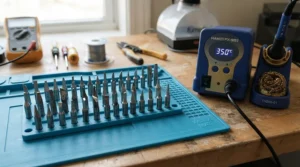
Station Stand and Sponge: Daily Tip Care That Protects Your Tip Stock
The humble station stand and sponge are the cheapest tip-saving tools on the bench. A dirty tip transfers heat poorly, and the cure is simple habit: keep a shiny layer of fresh solder on the tip and wipe it before each joint.
Each station here ships with a different holder. The Weller WE1010NA includes the PH70 safety rest with a sponge. The Hakko FX-888DX typically ships with an FH-800 holder that includes a cleaning sponge and cleaning wire. The Hakko FX-971 uses the FH-215 holder, and the JBC CD-2BF stores up to four cartridges in its holder.
Two practical pointers. First, use a damp sponge, never a soaked one, because the thermal shock of cold water can stress a hot tip. Many technicians prefer brass wool for exactly that reason, so keep both around and pick what suits each tip. Second, tin the tip before returning it to the holder at the end of the day. An oxidized, bare tip is the one most likely to refuse solder tomorrow morning.
Treat the stand like a safety device, not an accessory. A stable rest that keeps the hot tip away from cables and plastic is cheap insurance for the very stations that cost real money.
Real-World Scenarios: Matching a Station to Your Shop
Scenario 1: The phone-repair kiosk startup. A new kiosk handles a dozen screen and battery jobs a day, with occasional charging-port work, on a tight budget. The YIHUA 926 III gets the doors open with six tips included. Plan to move up to a Hakko FX-888DX once volume climbs.
Scenario 2: The laptop and console shop. Daily DC-jack, HDMI-port and fan-header repairs mean ground planes and bigger joints. The Weller WE1010NA or the Hakko FX-888DX handles that workload with predictable heat and plentiful tips.
Scenario 3: The micro-soldering specialist. Board-level repairs on 0402 parts and fine-pitch ICs reward finer tips and dual handles. The AIXUN T420D, JBC CD-2BF or Metcal MX-5200 fits, depending on budget and whether tweezers or desoldering belong in the same system.
Scenario 4: The three-technician shop. Shared stations get abused, so locked settings and a modular upgrade path matter. The Hakko FX-971 (or its dual-port sibling) suits that environment, as long as the tip budget is planned.
✨ Don’t Miss These Exclusive Deals!
🔍 Take your repair bench to the next level with these carefully selected stations. Click on any highlighted product name to check current pricing and availability. The right station will help you complete cleaner, more reliable repairs your customers will notice!
How to Choose a Soldering Station With Extra Tips for Repair Shops
- Match the tip ecosystem to your work first. A station is only as versatile as the tips you can buy for it. Count the shapes available and how easily you can reorder them.
- Check the heater power against your heaviest job. Ground planes and large connectors punish low-wattage handpieces, while micro work rewards fast, controlled heat.
- Look for published stability and recovery claims. A ±1°C or ±3°C figure is a hint that the control loop is built for repeatability.
- Verify ESD documentation. Look for tip-to-ground resistance and potential figures, not just the words “ESD safe.”
- Count the tips actually in the box. Many professional stations ship with one or none, so budget a starter assortment.
- Plan for growth. A station that accepts micro, tweezer or nitrogen handpieces saves a second purchase later.
- Check warranty and support. Reseller-dependent warranties matter more for imported stations.
Replacement Tip Variety: What to Stock Before Your First Rush
Replacement tip variety is what separates a station that handles a job from one that handles the whole counter. A sensible starter assortment covers five shapes:
- Chisel or screwdriver (1.6-2.4 mm): the all-rounder for through-hole joints, shields and connectors.
- Fine conical: precision work on small pads and fine-pitch pins.
- Bevel or hoof: good for drag soldering.
- Knife: another drag-soldering shape for rows of pins.
- Micro or needle tips: the right choice for tiny passives and delicate repairs.
Cost behaves very differently across ecosystems. Budget YIHUA 926 III tips cost a few dollars each, while genuine cartridges for the premium systems can climb well into double digits, which is why the JBC CD-2BF and Metcal MX-5200 need a cartridge budget. The Hakko FX-888DX (T18), Weller WE1010NA (ET) and Hakko FX-971 (T39) sit between those extremes.
Buy the first set in a week of calm, not a week of panic. Then keep one spare of the shape you wear out fastest, usually the chisel. A shop that keeps duplicates of its two workhorse tips almost never loses a day to a dead tip.
Soldering Station With ESD Safe Grounding for Micro Soldering
The best soldering station with ESD safe grounding for micro soldering does two jobs at once: it keeps heat stable, and it prevents static from reaching the part. Micro soldering is where static damage hides, because tiny components can be damaged by discharges too small to feel.
Grounding is the foundation of an ESD program. According to InCompliance’s summary of ANSI/ESD S20.20 grounding requirements, personnel and equipment grounding is the first step in a compliant plan. In practice, that means a wrist strap (rated well under the 35-megohm limit cited in common guidance) connected to a common-point ground, not just snapped onto a mat.
Station-level numbers matter too. The two Hakko stations publish tip-to-ground resistance under 2 ohms and potential under 2 mV. The Metcal MX-5200 power supply adds AC ground monitoring. For the AIXUN T420D and JBC CD-2BF, ask for current documentation from the seller before you rely on them in an ESD-controlled area.
A simple routine keeps everything honest: test wrist straps on a regular schedule (many programs use roughly every six months or more often), check the outlet’s ground with a simple tester, and label ESD-safe tweezers so they never mix with ordinary ones.
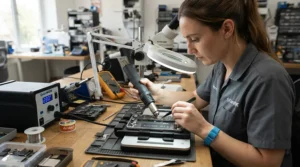
Soldering Station Kit for Repair Shops vs Buying Components
A soldering station kit for repair shops is tempting because everything arrives together. The question is whether a bundle like the YIHUA 926 III (helping hands, six tips, solder, tweezers) beats assembling components over time.
| Option | Upfront Cost | Tip Variety | Downtime Risk | Best For |
|---|---|---|---|---|
| Entry kit (YIHUA 926 III) | Lowest | Good out of the box | Moderate (QC variance) | Startups, training |
| Pro single-port (Hakko FX-888DX, Weller WE1010NA) | Mid | Broad, bought separately | Low | General repair benches |
| Cartridge / dual system (JBC CD-2BF, AIXUN T420D, Metcal MX-5200) | High | Very broad | Lowest | Micro-soldering, high volume |
| Basic unregulated pencil iron | Very low | Limited | High | Occasional hobby use |
Kits win on speed to first repair, while component-built benches win on durability and the ability to match each part to a task. The cheapest option fails the most expensively: unregulated heat means ruined boards and warranty headaches. If you start with a kit, treat it as a first station and plan to upgrade once volume justifies it.
Long-Term Cost and Maintenance
The sticker price is only the opening bid. Total cost of ownership is a simple sum: station + tips replaced over time + downtime when something fails. A cheaper station with fragile tips and quality variance can cost more across a year than a pricier one that stays working.
Think in cost per repair. If a tip dies earlier because of poor care, the loss is the tip plus the time to swap and re-calibrate. That is why the sleep modes on the JBC CD-2BF, Hakko FX-971 and Metcal MX-5200 matter; they reduce idle heat on a tip that would otherwise sit at full temperature. JBC’s own claim of five-fold tip life from sleep and hibernation is a manufacturer figure, so treat it as directional.
Maintenance is mostly habit. Tin the tip at the end of the day, clean it before each joint, check calibration against a thermometer at regular intervals, and keep spare tips for the two shapes you wear out fastest. A well-kept Hakko FX-888DX or Weller WE1010NA can serve a shop for years, and cheaper stations like the YIHUA 926 III are best treated as replaceable.
Common Mistakes When Buying a Repair-Shop Soldering Station
- Buying on wattage alone. A 200W label means little if the tips you need don’t exist or cost a fortune.
- Ignoring the tip ecosystem. Switching later means rebuying every tip, because the Weller WE1010NA won’t accept Hakko tips.
- Assuming “ESD safe” is verified. Ask for tip-to-ground numbers, especially on imported stations.
- Forgetting the tip budget. The Hakko FX-971 ships with no tips, and others include only one.
- Skipping calibration. Trust but verify the displayed temperature with a reference thermometer.
- Buying a kit and never upgrading. The YIHUA 926 III is a fine start, not a ten-year plan for a busy counter.
- Overlooking reseller support. Warranty terms vary, particularly on imported premium stations.
Safety, Fume Extraction and Lead Handling
Solder is a regulated material, and a repair shop is a workplace. OSHA’s lead standard sets a permissible exposure limit of 50 micrograms of lead per cubic meter of air as an eight-hour average, as explained in OSHA’s interpretation letter on soldering and lead exposure. Hand soldering at typical temperatures rarely produces airborne lead, according to university safety guidance, but ingestion from contaminated surfaces and hands is the more likely route.
The practical rules are straightforward. Wash hands before eating, keep food away from the bench, wipe the work area, and dispose of lead solder dross properly. Flux fumes are the more immediate concern. Rosin flux fume is an irritant and a recognized cause of occupational asthma, so extraction at the source, positioned 4-8 inches from the joint, beats any respirator.
Some stations integrate with extraction: the JBC CD-2BF connects to JBC’s fume extractor through its RJ12 port. If you employ staff, check the relevant requirements for your location, and when in doubt, ask your local safety authority.
FAQ
❓ How many replacement tips should a repair shop keep on hand?
❓ Can I use Hakko tips on a Weller station?
❓ What wattage works best for phone and laptop repair?
❓ Is a soldering station kit good enough for a professional shop?
❓ Do ESD-safe stations still need a wrist strap?
Conclusion
Choosing a soldering station with extra tips for repair shops comes down to three questions: which tips can you reorder easily, how much heat do your toughest jobs need, and how much documentation backs the ESD claims? Start there, and the rest of the decision gets a lot easier.
For most shops, the Hakko FX-888DX and Weller WE1010NA are the dependable, low-regret choices, with the YIHUA 926 III as the budget on-ramp when a kit makes sense. Growing teams will appreciate the Hakko FX-971 and its upgrade path. Specialists doing fine-pitch work should look hard at the AIXUN T420D, JBC CD-2BF or Metcal MX-5200, and verify ESD paperwork before buying.
Whatever you pick, budget for tips, build the bench around the station, keep it clean, and ground everything. A station doesn’t make you a better technician, but the right one with the right tips on the right bench removes every excuse. 🔧
Recommended for You
- [Add your blog post link 1]
- [Add your blog post link 2]
- [Add your blog post link 3]
Disclaimer: This article contains affiliate links. As an Amazon Associate, I earn from qualifying purchases. If you purchase products through these links, we may earn a small commission at no additional cost to you.
✨ Found this helpful? Share it with your friends! 💬🤗
